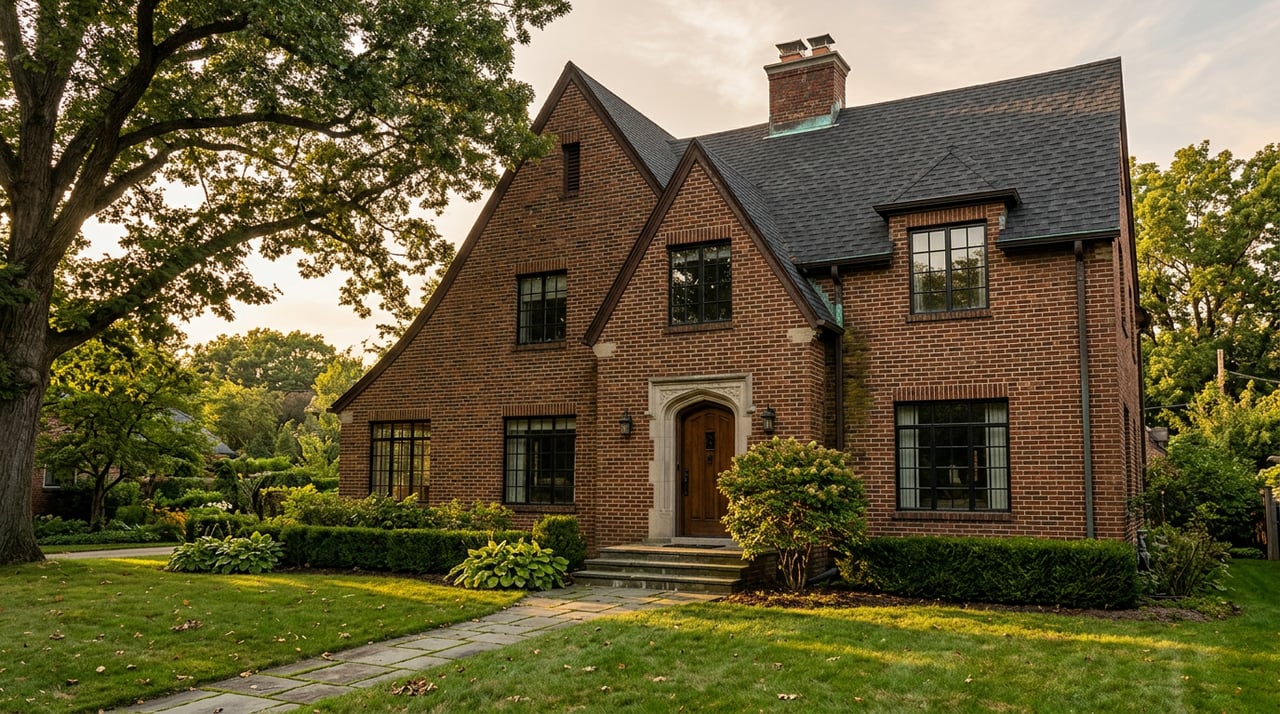
Western Springs Isn't a Sellers' Market. It's a No-Inventory Market.
September 17, 2026
September 17, 2026
Thirteen. That's how many detached homes were sitting active in Western Springs as of May 2026, in a village of roughly 4,544 housing units. Not thirteen percent. Thirteen homes, total, for anyone who wanted to buy a single-family house in one of the most requested addresses on the BNSF Metra line.
If you've been comparing Western Springs to La Grange or Hinsdale by pulling up a portal and reading the median, you've seen a story about a hot market. Prices up double digits year over year. Homes closing above asking. That story isn't wrong, but it isn't the useful part. The useful part is why it's happening, and the why has almost nothing to do with buyer enthusiasm and almost everything to do with a village that, for practical purposes, stopped building houses decades ago.
Pull three different sources and you'll get three different Western Springs medians, and that's worth pausing on before we go further. Redfin's three-month window ending in mid-2026 put the median sale price at $1.1 million, up 18.1% year over year, with homes selling after 38 days on market. Zillow's home value index, updated at the end of May 2026, showed an average value of $898,566, up 10.8% over the prior year. Neither is wrong. They're measuring different things over different windows, which is exactly the problem with treating any single median as the whole picture.
The trailing 12-month figure from MRED, the regional multiple listing service that actually records closed transactions, tells a cleaner story: a detached median of $940,000 for the year ending in May 2026, climbing to $995,000 by the trailing 12 months ending in July, an increase of 13.2% year over year in that later reading. Two months, roughly $55,000 in trailing median movement. That's not noise. That's a market where the number keeps changing while you're still deciding whether to write an offer.
Here's the figure that does the real explaining, and it's not on the price line at all. Western Springs closed somewhere between 171 and 189 detached homes in the trailing 12 months depending on which window you use, and for most of that stretch, active inventory sat at 13 homes. That's not a typo and it's not a snapshot of a slow week. It's a village where the number of homes for sale at any given moment is smaller than the number of homes that close in a single month.
Homes have sold at 102% to 103% of original list price in every recent reading, whether you're looking at the May trailing-12-month figure of 102.1%, the same period's monthly read of 103.5%, or the July trailing-12-month figure of 102.2%. That consistency across different time windows is itself a signal. This isn't a market having one unusually competitive month. It's a market where the ratio barely moves because the underlying scarcity doesn't either.
Put Western Springs next to its neighbors on the same BNSF corridor and the pattern holds village to village, but the degree varies. La Grange ran a 103.2% list-to-sale ratio with homes averaging just 7 days on market in May 2026, the fastest absorption read among the corridor towns tracked that month. Hinsdale, at the other end, showed a milder 98.8% ratio across 202 closed sales, a market large enough and expensive enough that buyers can be more selective. Western Springs sits between them, both in price and in temperament.
| Town | Trailing 12-Month Detached Median (period ending May 2026) | List-to-Sale Ratio | What Inventory Looked Like |
|---|---|---|---|
| La Grange | ~$775,000 | 103.2% | Fastest absorption in the corridor, 7 avg. days on market in May |
| Western Springs | $940,000 | 102.1% | 13 active listings, down 56.7% year over year |
| Hinsdale | $1,425,000 | 98.8% | 202 closed sales, larger luxury tier, more buyer selectivity |
Westmont, in the same regional dataset, saw its own detached inventory fall 50% year over year to just 8 homes. So Western Springs isn't uniquely starved. It's an extreme version of a pattern showing up across the corridor, where new listings are getting absorbed faster than sellers are bringing homes to market.
The reason Western Springs can't simply produce more inventory when demand rises is architectural, not attitudinal. The median year built across the village's housing stock sits around 1960. Only about 8.7% of homes were built in 2010 or later. Compare that to a growth suburb where new subdivisions are still being platted, and you're looking at two entirely different supply mechanisms. In a growing town, a price spike eventually pulls new construction online and the market cools itself. In Western Springs, there's no undeveloped land left to build on, so the price spike just sits there until enough existing owners decide to sell.
That's not a temporary condition waiting for the next building boom. It's closer to a structural ceiling. Roughly 89% of the village's housing units are detached single-family homes, and the vast majority of them were built before most of today's buyers were born. What exists is what trades. There's no pipeline behind it.
You can see the village's civic energy going into maintaining what's already there rather than expanding what exists. The Village of Western Springs is currently in the middle of a full reconstruction of Woodland Avenue between Burlington Avenue and 47th Street, a nearly $3 million project covering new curb and gutter, sidewalk replacement, storm sewer work, and lead water service line replacement for eight homes, funded through a 2025 infrastructure bond referendum. That's the kind of capital project a built-out village runs. You're not carving new streets. You're rebuilding the ones you have.
There's a single meaningful carve-out to the built-out story, and it's worth knowing by name if you're shopping here: Timber Trails, a 338-unit subdivision developed on a former golf course, annexed into the village through a special assessment bond arrangement handled by the law firm Klein, Thorpe and Jenkins. A newer phase of the development, built out by McNaughton Development starting in 2016, is still delivering luxury single-family homes today, with new listings running well above $1 million and some new construction priced past $2 million.
Timber Trails is the exception that proves the rule. It exists because the land was already assembled and entitled as a single large parcel decades ago, not because Western Springs has an open pipeline for new subdivisions elsewhere. If you want new construction with a builder warranty and a floor plan you can still customize, Timber Trails is functionally the only place in the village where that's currently possible. Everywhere else, you're buying into the existing stock, whatever decade it happens to be from.
If you're cross-shopping La Grange, Western Springs, and Hinsdale, the practical takeaway isn't which town has the better median. It's that these three markets behave differently because their supply mechanics are different, not just because their price points are different.
La Grange's faster turnover and larger sales volume mean more chances to find a home in your window, even in a tight market. Western Springs' near-zero inventory means the search itself takes longer, and when a home does list, the decision window is short. Hinsdale's larger luxury tier and slightly softer list-to-sale ratio mean buyers there have a bit more room to be selective, in part because the price point filters out a broader competitive pool.
None of that shows up in a median price comparison. It shows up when you're actually trying to write an offer and discover there were only two comparable homes to look at in the last quarter, not twenty.
A few things follow from that for anyone seriously considering a move into Western Springs:
Is Western Springs likely to see more inventory soon? Not structurally. With the village essentially built out and new construction limited to Timber Trails, the number of homes for sale depends almost entirely on how many current owners decide to move, not on new supply coming online.
Why do some Western Springs listings say "new construction" if the village has no room to build? Nearly all of it traces back to Timber Trails, the former golf course subdivision still being built out in phases. Outside that development, new construction in Western Springs is rare.
Is La Grange a better bet if inventory is the concern? It depends on what you're optimizing for. La Grange offers more volume and faster turnover at a lower median, but it's tight in its own right, with the fastest average days on market of any town in the corridor comparison. The trade isn't inventory versus no inventory. It's degree.
If you're trying to figure out where you actually fit in this corridor, whether that means competing for one of the thirteen, exploring what Timber Trails still has coming, or deciding La Grange's faster pace suits your search better, that's the kind of conversation worth having before you start touring. Deidre Rudich works this stretch of the BNSF line closely enough to know which of these three markets actually fits your search, not just which one has the number you liked on a portal. Schedule your complimentary market consultation and let's map out where you'd actually land.
Stay up to date on the latest real estate trends.
Whether you're seeking expert guidance on the market trends, property valuations, or specific neighborhoods, Deidre is ready to provide you with tailored solutions and personalized support. Send her a message through the contact form below, and she will be with you every step of the way.